Converting Fractions and Decimals
25 conversion problems on two pages. About half turn a fraction into a decimal, like 17/25, and the rest turn a decimal into a fraction in lowest terms, like 0.35. Every denominator divides evenly into 100, so the decimals come out to one or two places. It fits 4th through 6th grade.
Worksheet Preview
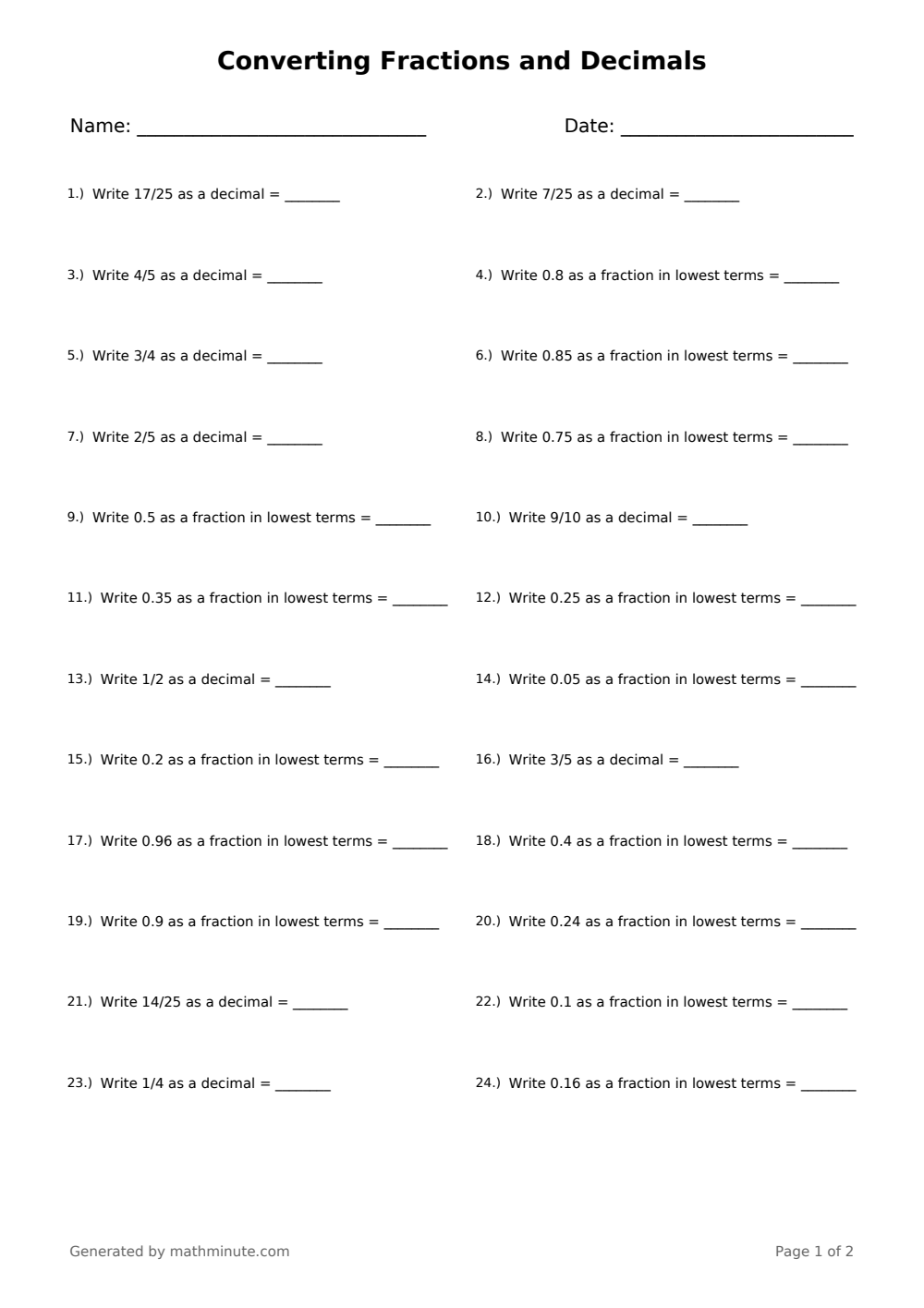
Going through hundredths
Every fraction here can be rewritten as hundredths. For 17/25, multiply the top and bottom by 4 to get 68/100, which is 0.68. For 13/20, multiply by 5 to get 65/100, or 0.65. Knowing what to multiply by is most of the skill, so it helps to know that 4 × 25, 5 × 20, and 2 × 50 all make 100.
The other direction starts by reading the decimal out loud. 0.35 is thirty-five hundredths, so write 35/100 and simplify. Both numbers divide by 5, which gives 7/20. Students often stop at 35/100, but the answer key wants lowest terms.
A few benchmarks save time: 1/2 = 0.5, 1/4 = 0.25, 3/4 = 0.75, and 1/5 = 0.2. The fraction, decimal, and percent chart has them on one page.
Frequently Asked Questions
How do you turn a fraction into a decimal?
Divide the top by the bottom. For fractions like the ones on this sheet it's quicker to scale to a denominator of 100: 7/25 is 28/100, which is 0.28.
What does lowest terms mean?
The top and bottom have no common factor except 1. 24/100 isn't in lowest terms because both numbers divide by 4, which gives 6/25.
Why is 0.5 equal to 1/2 and not 5/100?
0.5 is five tenths, not five hundredths. One digit after the point means tenths and two digits mean hundredths. So 0.5 = 5/10, which simplifies to 1/2.