Printable Subtracting 7 Flash Cards
Subtracting 7 covers 8 − 7 through 19 − 7 — the family with the fewest shortcuts and the strongest case for fact families: 16 − 7 is answered by knowing 7 + 9 = 16, and very little else helps.
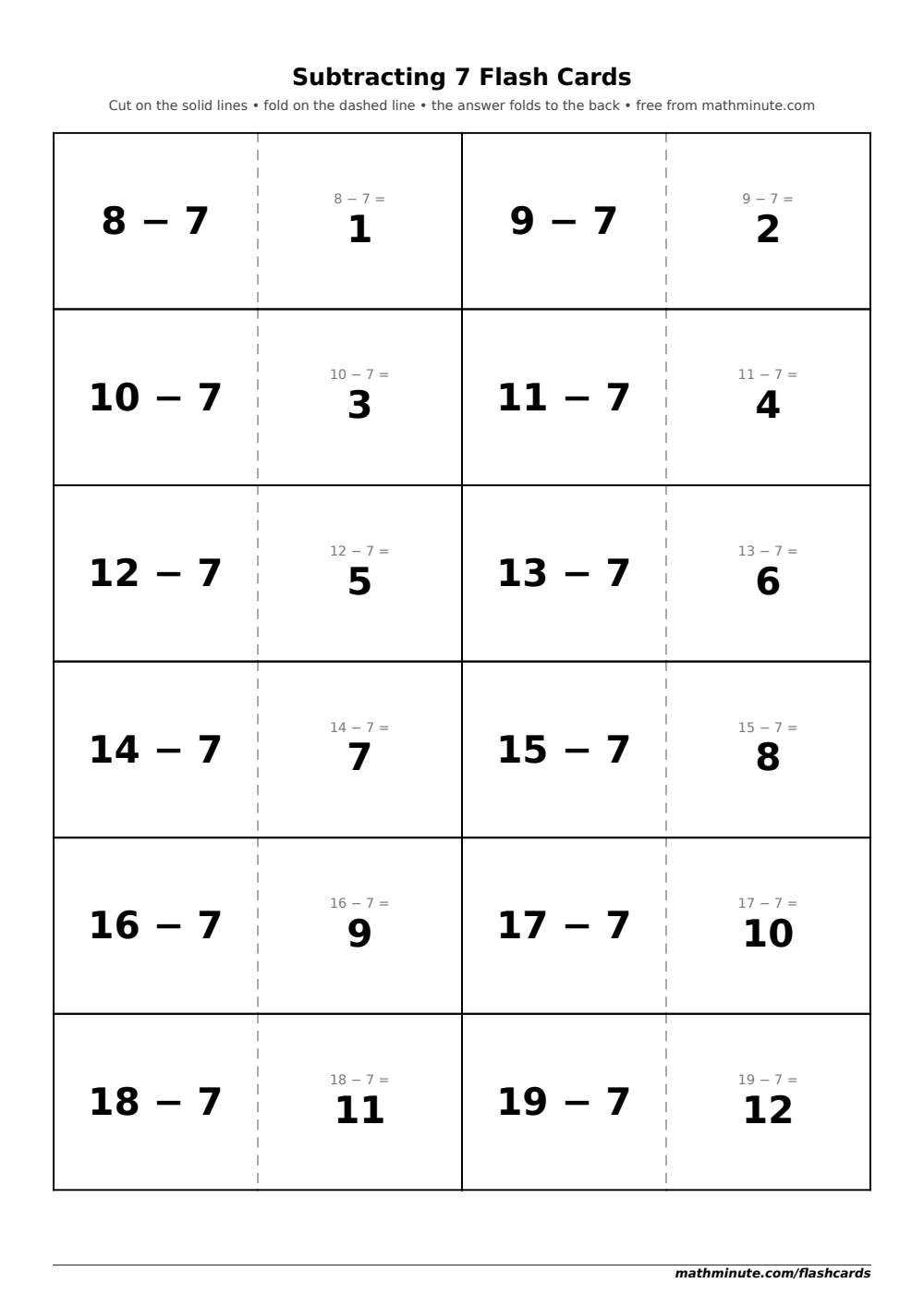
How to Use These Flash Cards
Make the addition flip explicit on every card: say "7 plus what?" before answering. The double's half, 14 − 7 = 7, anchors the middle of the deck; 15 − 7 = 8 and 16 − 7 = 9 are the classic stubborn pair. If they stall, drill 7 + 8 and 7 + 9 in the same session, so both directions strengthen together.
How to Cut and Fold
- Print the PDF single-sided on plain paper or light cardstock.
- Cut along the solid lines to separate the cards.
- Fold each card along the dashed center line so the answer sits behind the question, and turn the card over like a page to check.
- Optional: a dab of glue inside the fold makes a sturdy double-thick card.
Frequently Asked Questions
Why are −7 facts among the hardest subtractions?
For the same reason +7 is hard: seven is neither small nor round, so counting and five-frame shortcuts run out. The facts rest on their addition twins, which is exactly what fact-family drilling builds.
What is the fastest route to 15 − 7?
Think addition: 7 + 8 = 15, so the answer is 8. The bridge works as backup — 15 back to 10 takes 5, then 2 more of the 7 lands on 8 — but the fact family is one step instead of two.
What does 14 − 7 = 7 anchor?
It is the half of the double 7 + 7 = 14. Halves are as memorable as doubles, and neighbors sit within reach of it: 15 − 7 is one more (8), and 13 − 7 is one less (6).