Printable Addition Chart 1–12
Every addition fact from 1 + 1 to 12 + 12 on one ink-friendly page. The shaded diagonal marks the doubles (2, 4, 6 … 24) — the anchor facts that the strongest mental-math strategies are built on. Download the filled chart as a reference, or the blank version as a fill-in exercise that doubles as a self-test.
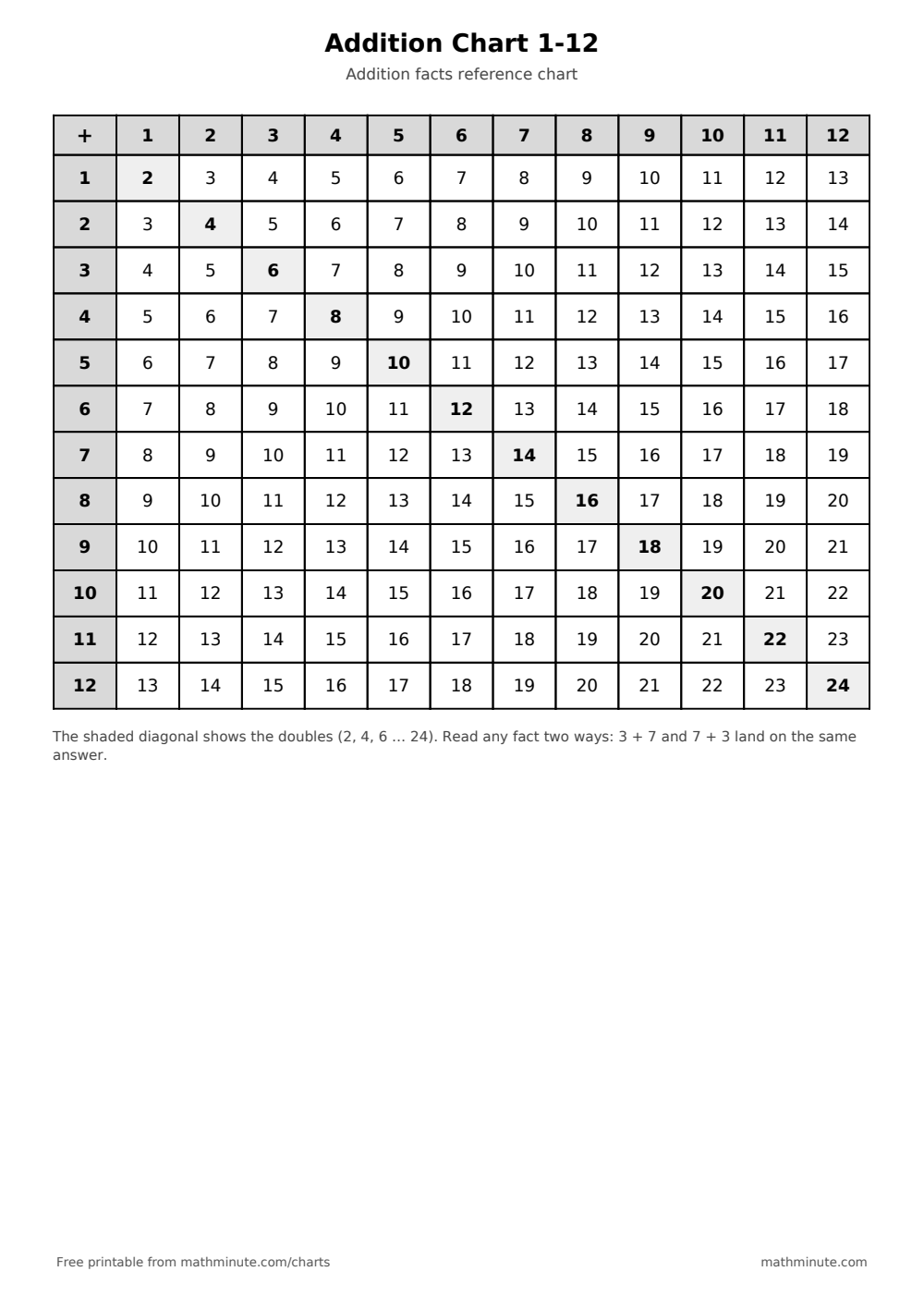
The Addition Chart at a Glance
| + | 1 | 2 | 3 | 4 | 5 | 6 | 7 | 8 | 9 | 10 | 11 | 12 |
|---|---|---|---|---|---|---|---|---|---|---|---|---|
| 1 | 2 | 3 | 4 | 5 | 6 | 7 | 8 | 9 | 10 | 11 | 12 | 13 |
| 2 | 3 | 4 | 5 | 6 | 7 | 8 | 9 | 10 | 11 | 12 | 13 | 14 |
| 3 | 4 | 5 | 6 | 7 | 8 | 9 | 10 | 11 | 12 | 13 | 14 | 15 |
| 4 | 5 | 6 | 7 | 8 | 9 | 10 | 11 | 12 | 13 | 14 | 15 | 16 |
| 5 | 6 | 7 | 8 | 9 | 10 | 11 | 12 | 13 | 14 | 15 | 16 | 17 |
| 6 | 7 | 8 | 9 | 10 | 11 | 12 | 13 | 14 | 15 | 16 | 17 | 18 |
| 7 | 8 | 9 | 10 | 11 | 12 | 13 | 14 | 15 | 16 | 17 | 18 | 19 |
| 8 | 9 | 10 | 11 | 12 | 13 | 14 | 15 | 16 | 17 | 18 | 19 | 20 |
| 9 | 10 | 11 | 12 | 13 | 14 | 15 | 16 | 17 | 18 | 19 | 20 | 21 |
| 10 | 11 | 12 | 13 | 14 | 15 | 16 | 17 | 18 | 19 | 20 | 21 | 22 |
| 11 | 12 | 13 | 14 | 15 | 16 | 17 | 18 | 19 | 20 | 21 | 22 | 23 |
| 12 | 13 | 14 | 15 | 16 | 17 | 18 | 19 | 20 | 21 | 22 | 23 | 24 |
How to Use an Addition Chart
To find a sum, run one finger down from the top number and another across from the side number — the answer sits where they meet. Because addition works in either order, 3 + 7 and 7 + 3 meet at the same 10, which quietly halves the number of facts to learn. The other pattern worth pointing out: every step right or down adds exactly one, so the whole grid is really counting in disguise.
Teach the doubles diagonal first — kids pick up 6 + 6 = 12 fast — then show that the neighbors are one step away: 6 + 7 is a double plus one. The blank chart turns that insight into practice: fill in the diagonal from memory, build outward, and circle whatever needed a pause. When most of the grid comes back quickly, the timed addition facts game builds the speed.
Frequently Asked Questions
How do you read an addition chart?
Find one number in the top row and the other in the left column, then follow the row and column until they meet — that cell is the sum. For 6 + 8, go down from 8 and across from 6 to land on 14.
What patterns should kids notice on the addition chart?
Three big ones: the doubles run down the shaded diagonal, the grid is symmetric because 3 + 7 equals 7 + 3, and every step right or down adds exactly one. Spotting the patterns matters more than memorizing cell by cell.
What is the difference between an addition chart and a hundreds chart?
An addition chart looks up the sum of two numbers — row plus column. A hundreds chart is a counting map of 1 to 100 used for skip counting and place value. They complement each other: the addition chart drills facts, the hundreds chart shows why they work.