Printable Adding 7 Flash Cards
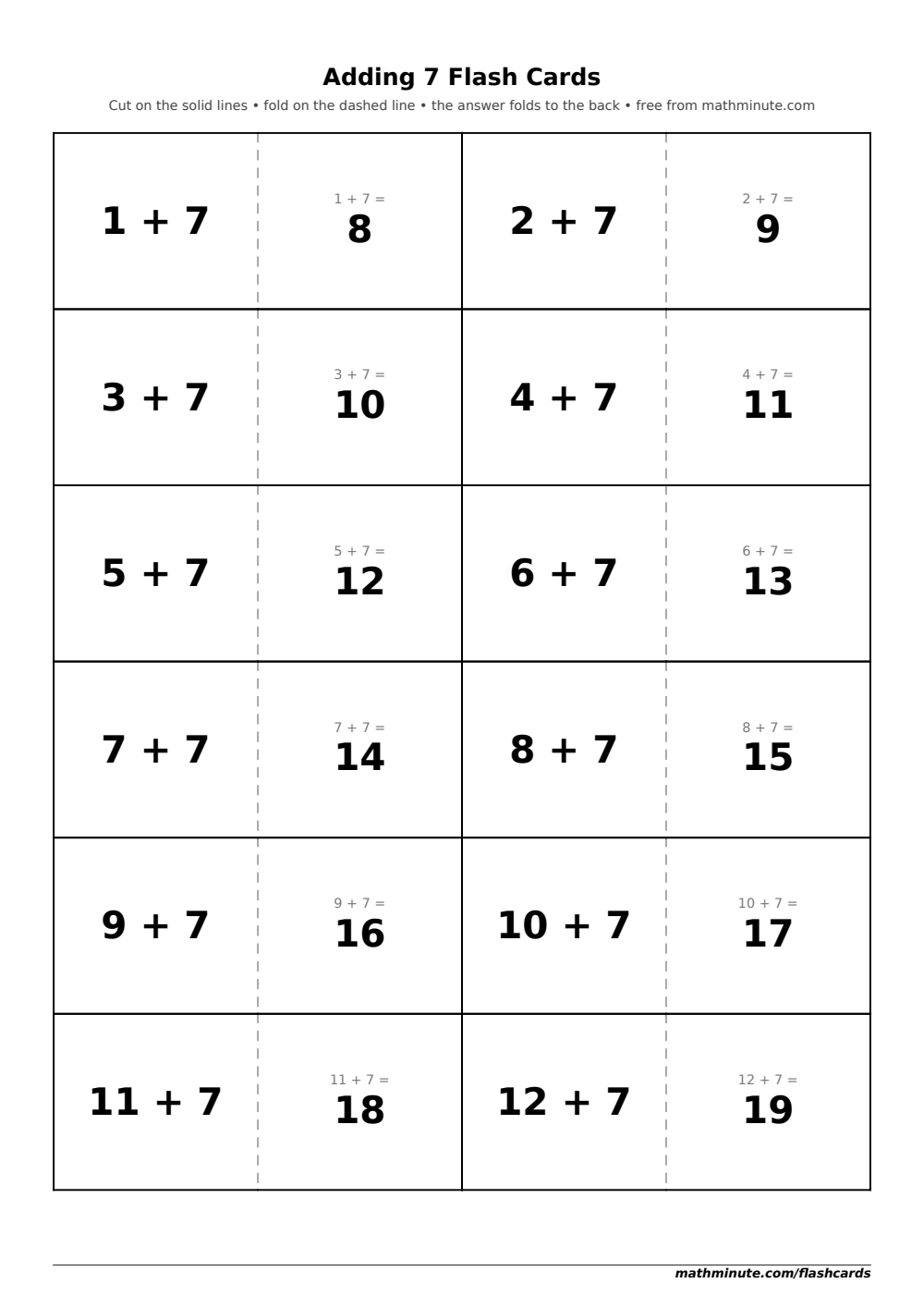
Adding 7 is one of the harder families: 7 is too big to count on and not round like 5 or 10. Two strategies cover it — the double 7 + 7 = 14, and make-ten for the facts that cross ten. These fold-over flashcards cover 1 + 7 through 12 + 7.
How to Use These Flash Cards
Two anchors carry the deck: 7 + 3 = 10 (the partner) and 7 + 7 = 14 (the double). From there, 8 + 7 is one more than the double, and 9 + 7 fills the 9 and leaves 6. Expect this family and +8 to need the most passes — that is normal, not a problem.
How to Cut and Fold
- Print the PDF single-sided on plain paper or light cardstock.
- Cut along the solid lines to separate the cards.
- Fold each card along the dashed center line so the answer sits behind the question, and turn the card over like a page to check.
- Optional: a dab of glue inside the fold makes a sturdy double-thick card.
Frequently Asked Questions
Why do +7 facts feel harder than +5 or +10?
Seven is not round and not small: counting on is too slow and there is no five-frame shortcut. The facts rest on the double 7 + 7 and the make-ten split, which simply take a little more practice to automate.
What is the fastest route to 8 + 7?
Either near-double — one more than 7 + 7 = 14, so 15 — or make ten: 8 takes 2 from the 7, leaving 5, so 10 + 5 = 15. Both land in two mental steps.
Is 7 + 7 = 14 worth memorizing on its own?
Yes. Doubles are the most memorable facts in the table (rhythm helps: seven-seven-fourteen), and each one unlocks its neighbors as near-doubles.