Printable Doubles Flash Cards
Doubles — 3 + 3, 7 + 7, 9 + 9 — are usually the first addition facts children remember, and the ones they use most. A child who owns the doubles answers the near-doubles for free: 7 + 8 is just 7 + 7 and one more. These fold-over flashcards cover 1 + 1 through 12 + 12.
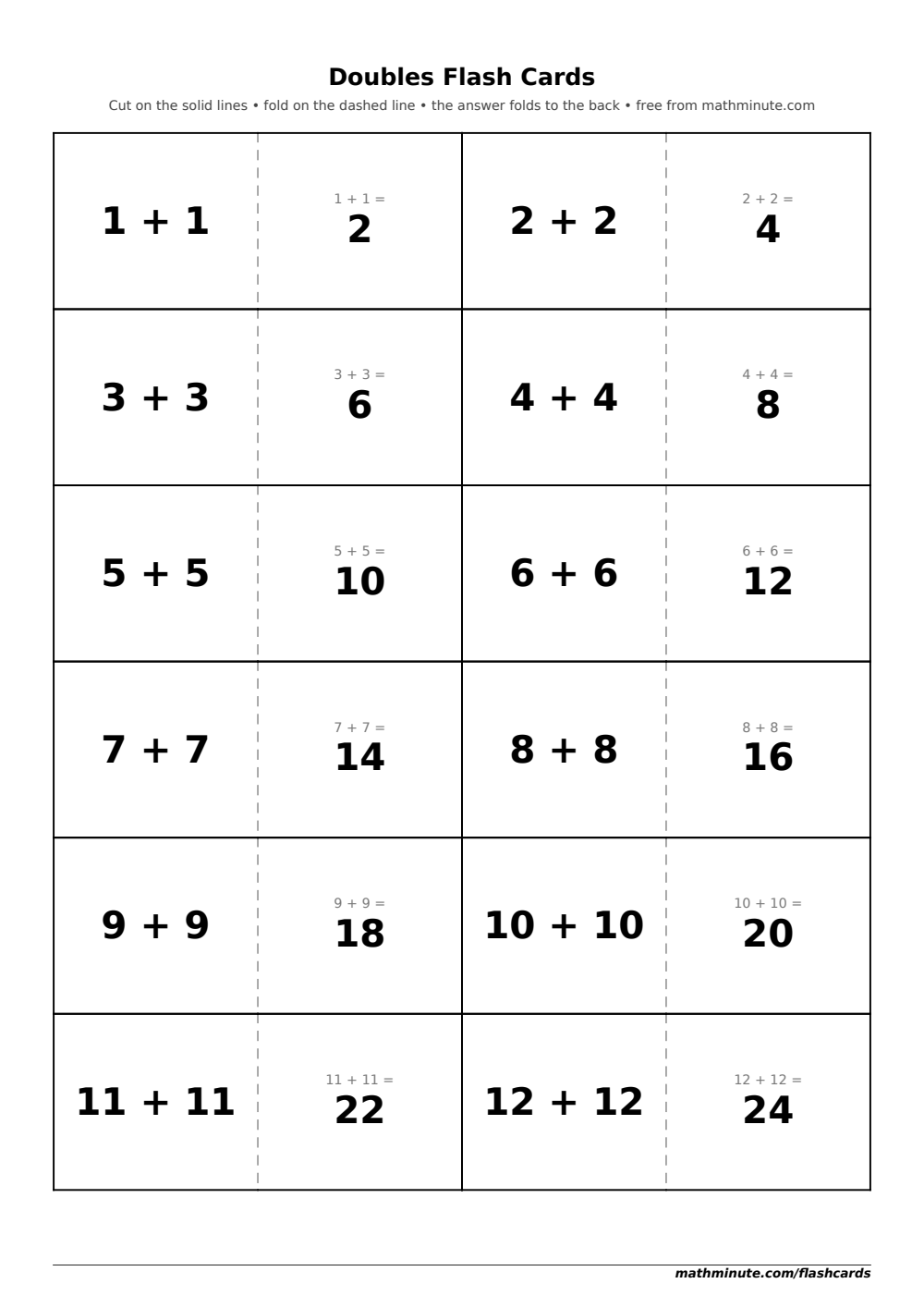
How to Use These Flash Cards
Doubles respond well to rhythm — chant them (two and two is four, three and three is six) and they stick. Run the deck for speed, then extend each flipped card into a near-double: if 6 + 6 is 12, what is 6 + 7? Every memorized double answers two or three neighboring facts.
How to Cut and Fold
- Print the PDF single-sided on plain paper or light cardstock.
- Cut along the solid lines to separate the cards.
- Fold each card along the dashed center line so the answer sits behind the question, and turn the card over like a page to check.
- Optional: a dab of glue inside the fold makes a sturdy double-thick card.
Frequently Asked Questions
Why are doubles the most important addition facts?
They are the easiest to memorize (rhythm and symmetry help) and they unlock the near-doubles strategy: 8 + 9 is one more than 8 + 8. One remembered double answers its whole neighborhood.
Which doubles stall most often?
7 + 7 = 14 and 8 + 8 = 16 — big enough to escape counting, without the roundness of 5 + 5 or 10 + 10. Rhymes and extra passes fix them; 6 + 6 = 12 usually arrives early because of egg cartons and clocks.
How do doubles connect to even numbers and halving?
Every double lands on an even number, and reading a double backward is halving: 8 + 8 = 16 means half of 16 is 8. The doubles deck quietly preps both multiplication by 2 and division by 2.