Printable Adding 2 Flash Cards
Adding 2 is counting on, two steps: 6 + 2 is two hops past 6. It also keeps the even-odd rhythm — an even number plus 2 stays even, an odd stays odd — so the answer always "sounds right". These fold-over flashcards cover 1 + 2 through 12 + 2.
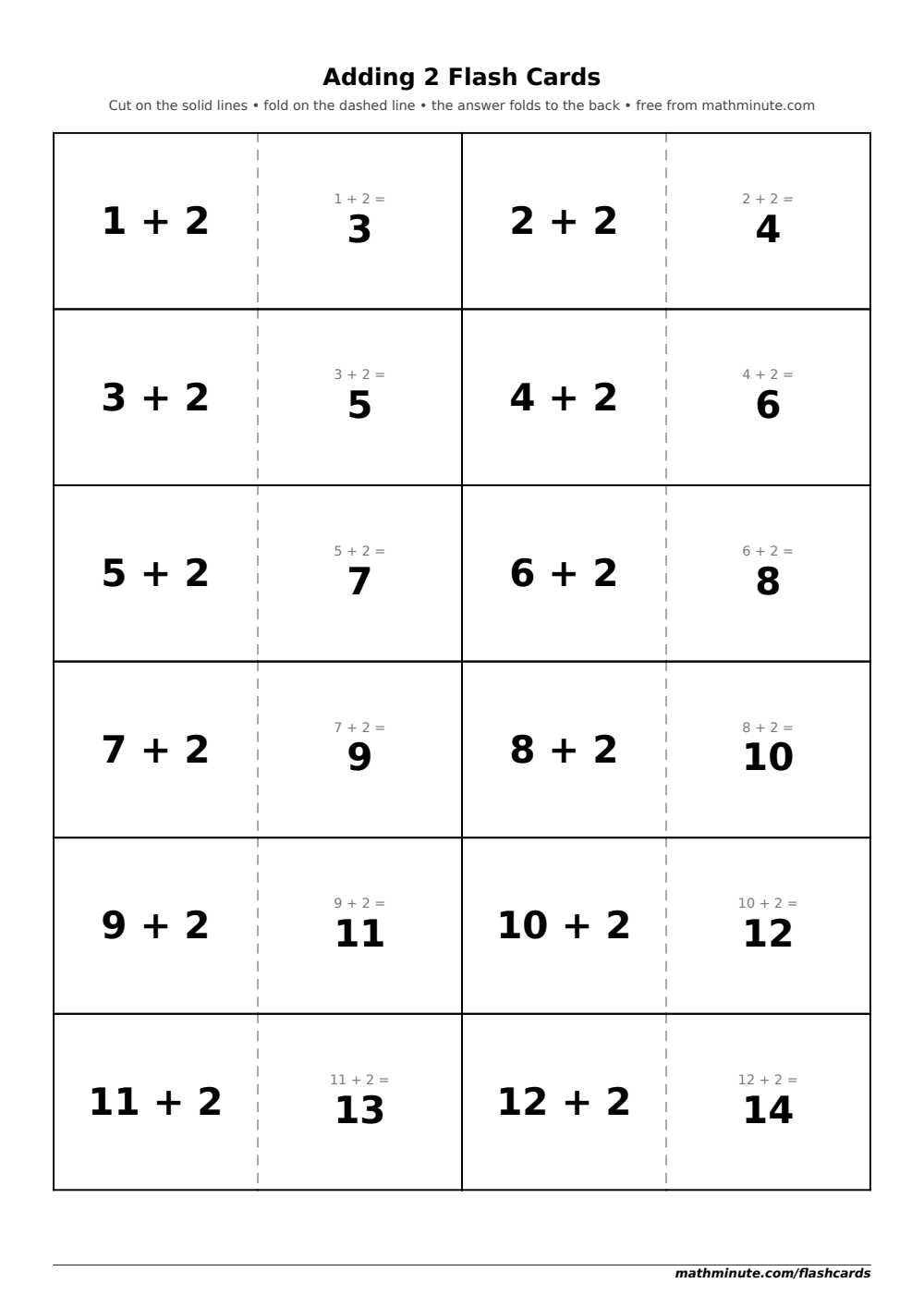
How to Use These Flash Cards
Have the child count on from the bigger number: for 9 + 2, say "9... 10, 11". Two hops is the comfortable limit of counting on, so this deck cements the strategy before the make-ten families replace it. Point out the even-odd pattern — it gives a free self-check on every card.
How to Cut and Fold
- Print the PDF single-sided on plain paper or light cardstock.
- Cut along the solid lines to separate the cards.
- Fold each card along the dashed center line so the answer sits behind the question, and turn the card over like a page to check.
- Optional: a dab of glue inside the fold makes a sturdy double-thick card.
Frequently Asked Questions
What is counting on, and why start it with +2?
Counting on means starting from one number and counting up the other: 9 + 2 is "9... 10, 11". One or two hops is fast and reliable; beyond three it gets slow and error-prone, which is why bigger families need different strategies.
Why do even and odd matter when adding 2?
Adding 2 never changes parity: even + 2 is even, odd + 2 is odd. So 7 + 2 must be odd — if a child says 10, the parity check catches it instantly.
Which +2 facts stall most?
The teen crossings: 9 + 2 = 11 and 12 + 2 = 14, where the count crosses ten or runs past the familiar range. Give those cards a few extra passes.