Printable Make Ten Flash Cards
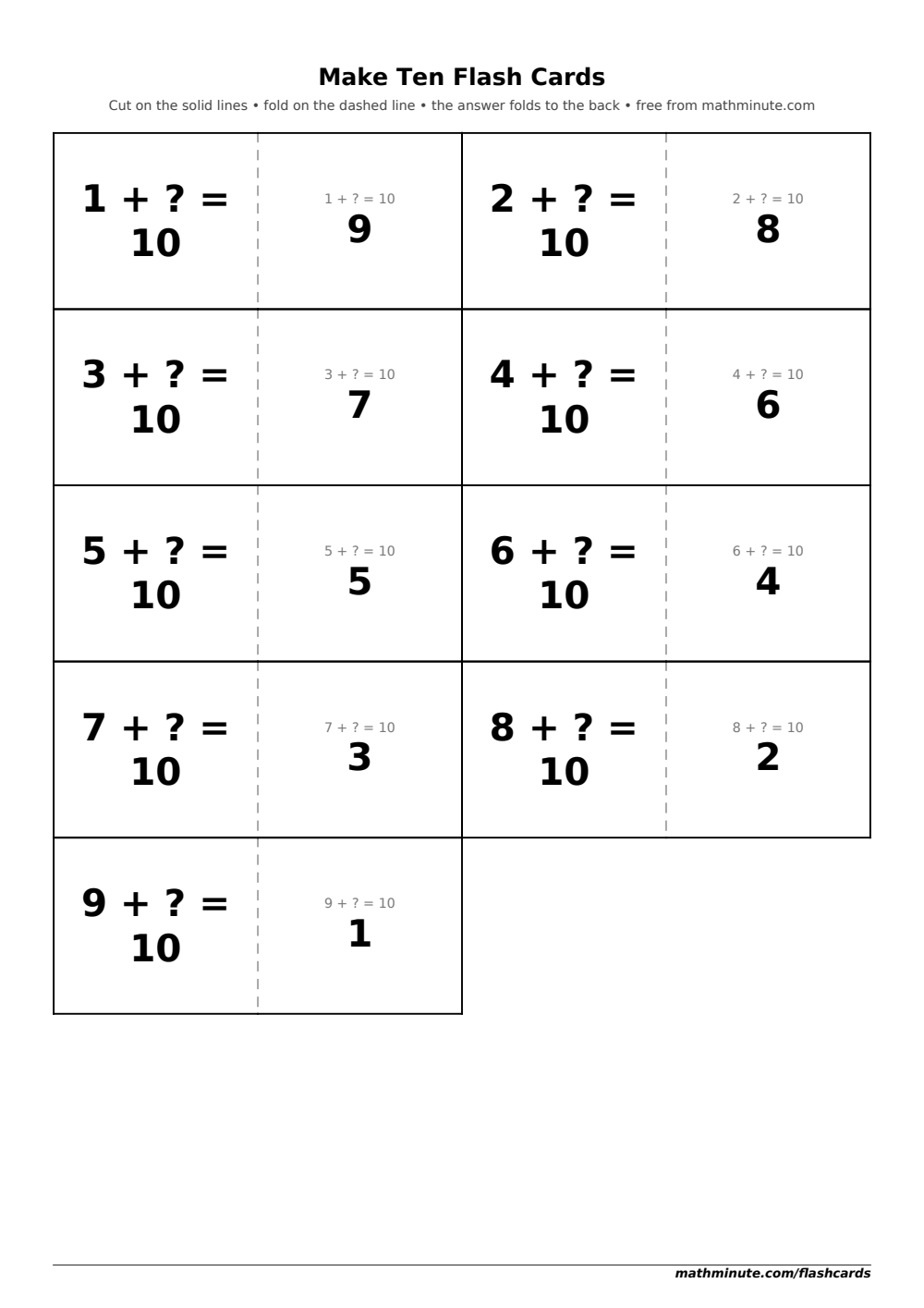
Make ten is the pair-knowledge behind almost every mental-math strategy: 7 needs 3, 6 needs 4, 8 needs 2. These cards drill the bonds in the form they are actually used — 7 + ? = 10 — the missing-addend question that is also a child's first taste of algebra. There are nine cards, and they get used everywhere.
How to Use These Flash Cards
Frame each card as a practical question: seven needs how many more to fill the ten-frame? Use real ten-frames or fingers early — 7 up, 3 down — then push for instant recall. Once the bonds are automatic, the make-ten strategy in the +6, +7, and +8 decks becomes much faster to use.
How to Cut and Fold
- Print the PDF single-sided on plain paper or light cardstock.
- Cut along the solid lines to separate the cards.
- Fold each card along the dashed center line so the answer sits behind the question, and turn the card over like a page to check.
- Optional: a dab of glue inside the fold makes a sturdy double-thick card.
Frequently Asked Questions
What are number bonds of ten?
The pairs that add to ten: 1 and 9, 2 and 8, 3 and 7, 4 and 6, 5 and 5. Knowing them cold is what makes crossing ten effortless in facts like 8 + 6 — the 8 grabs its partner 2 and the rest tags along.
Why are the cards written as 7 + ? = 10 instead of 7 + 3?
The missing-addend form is how the knowledge gets used — mid-calculation, the question is always "what does 7 need?" It is also gentle early algebra: an unknown in an equation, solved by number sense.
When should a child learn the make-ten pairs?
Late kindergarten through 1st grade, alongside ten-frames. They should be automatic before the harder addition families (+6 through +9), because those families' best strategies are built directly on the bonds.