Double Digit Subtraction with Regrouping
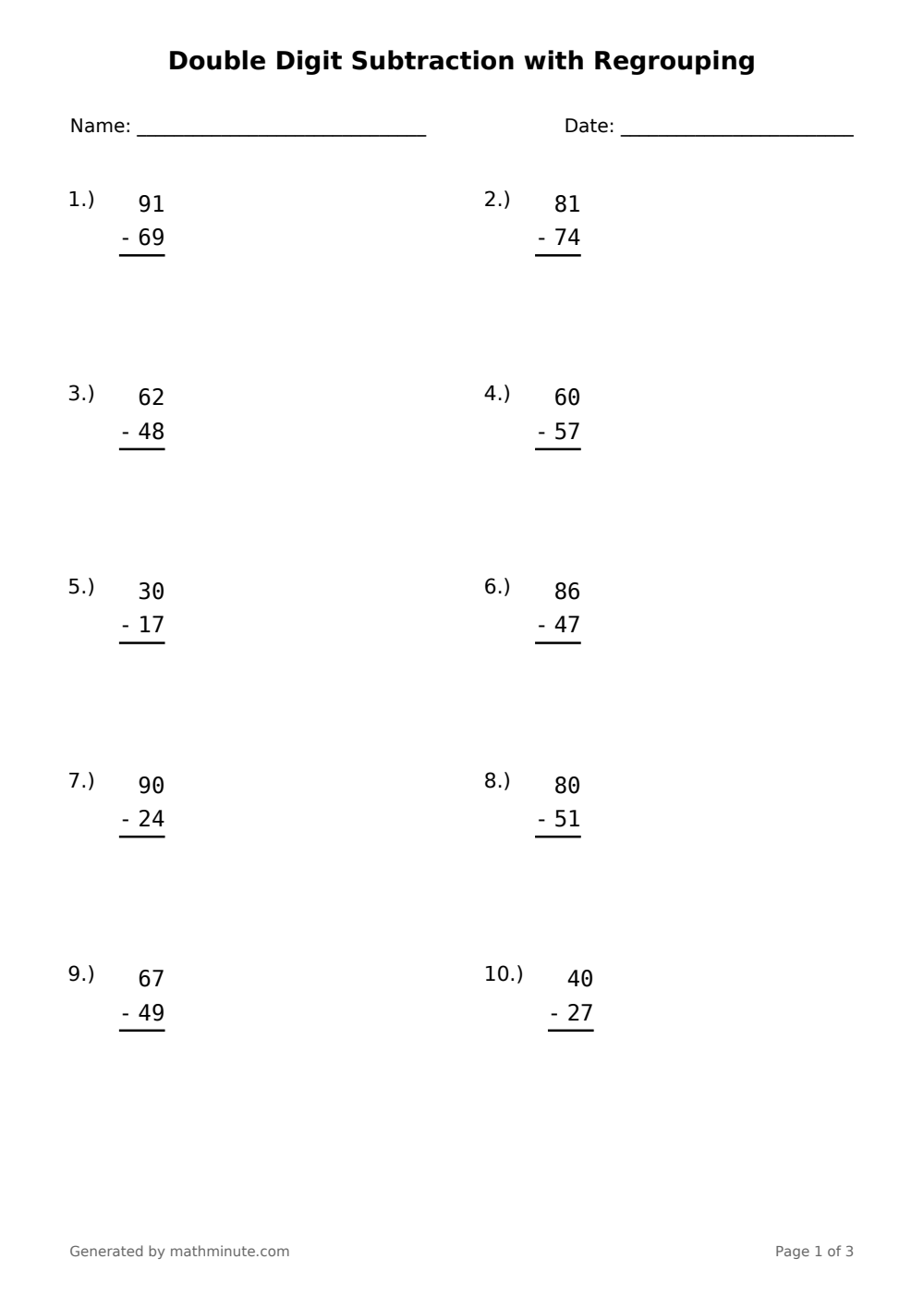
30 two-digit subtraction problems stacked in columns on three pages. In every one, the top digit in the ones column is smaller than the bottom digit, so a ten has to be regrouped into ones. It's for 2nd and 3rd graders who can already subtract without borrowing.
Worksheet Preview
Borrowing, and the problems with a zero
In 91 − 69, the 1 is too small to take away 9, so one of the 9 tens becomes ten ones. Cross out the 9 and write 8, and the 1 becomes 11. Then 11 − 9 = 2 and 8 − 6 = 2, for 22.
Problems with a 0 on top, like 60 − 57 or 90 − 24, trip up a lot of students. The usual mistake is to flip the ones and do 7 − 0 instead of borrowing, which turns 60 − 57 into 17 instead of 3. Before each problem, have students check whether the top digit in the ones is big enough.
Some answers are single digits, like 81 − 74 = 7, and that's fine. The regrouping guide explains why borrowing works.
Frequently Asked Questions
Is borrowing the same as regrouping?
Yes. Borrowing is the older word. Regrouping says what really happens: one ten is traded for ten ones, so the top number keeps the same value.
Why do kids subtract the smaller digit from the bigger one?
Because it worked on every earlier sheet, where the top digit was always bigger. Here it gives wrong answers like 60 − 57 = 17. Asking 'is the top digit big enough?' before each problem breaks the habit.
What grade learns subtraction with regrouping?
2nd graders learn it as part of subtracting within 100. Many still need practice in 3rd grade, especially with the problems that have a zero on top.