Printable Subtracting 5 Flash Cards
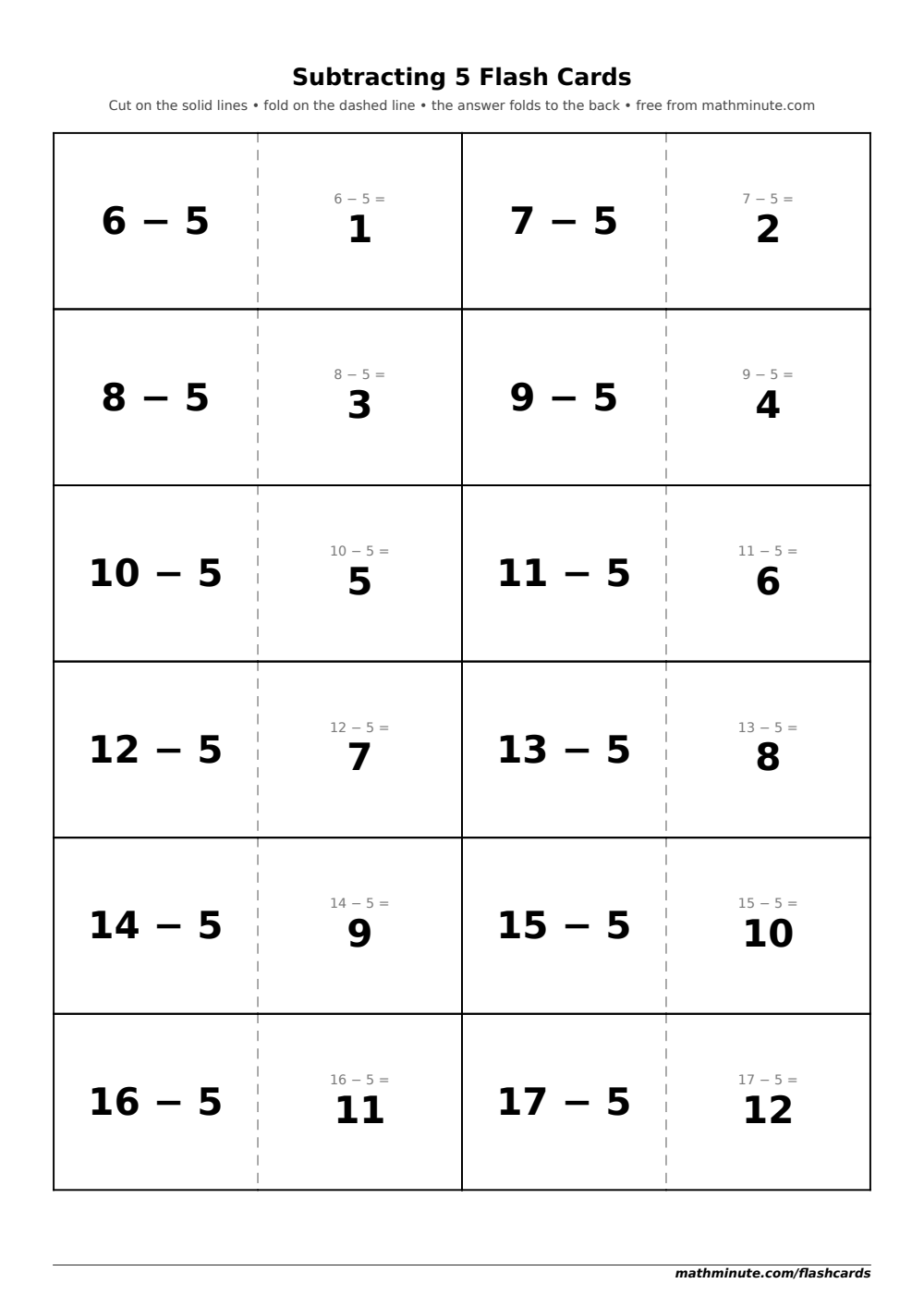
Subtracting 5 takes one full hand away. A child who sees numbers as "5 and some more" can peel the 5 right off: 13 is 5 + 5 + 3, so 13 − 5 is 8. Every teen minuend also bridges cleanly past 10. These fold-over flashcards cover 6 − 5 through 17 − 5.
How to Use These Flash Cards
Use hands and nickels: 12 cents minus a nickel is 7 cents. For teen cards, bridge: 14 − 5 goes back 4 to 10, then 1 more to 9. And keep 10 − 5 = 5 instant — it is the half fact the rest of the deck orbits.
How to Cut and Fold
- Print the PDF single-sided on plain paper or light cardstock.
- Cut along the solid lines to separate the cards.
- Fold each card along the dashed center line so the answer sits behind the question, and turn the card over like a page to check.
- Optional: a dab of glue inside the fold makes a sturdy double-thick card.
Frequently Asked Questions
What is the five-structure trick for subtracting 5?
See the minuend as fives and leftovers: 13 is 5 + 5 + 3, so removing a 5 leaves 5 + 3 = 8. Children who build numbers on five-frames read these answers straight off the structure.
How do coins make −5 concrete?
Taking a nickel away: 17 cents minus a nickel is 12 cents, which is 17 − 5. A handful of coins turns the whole deck into something a child can physically verify.
Why is 10 − 5 = 5 a key fact?
It is the half of ten — the anchor for bridging (15 − 5 is a whole hand off the teens) and the partner-fact hub that 6 − 5, 11 − 5, and 15 − 5 all navigate around.