Printable Adding 3 Flash Cards
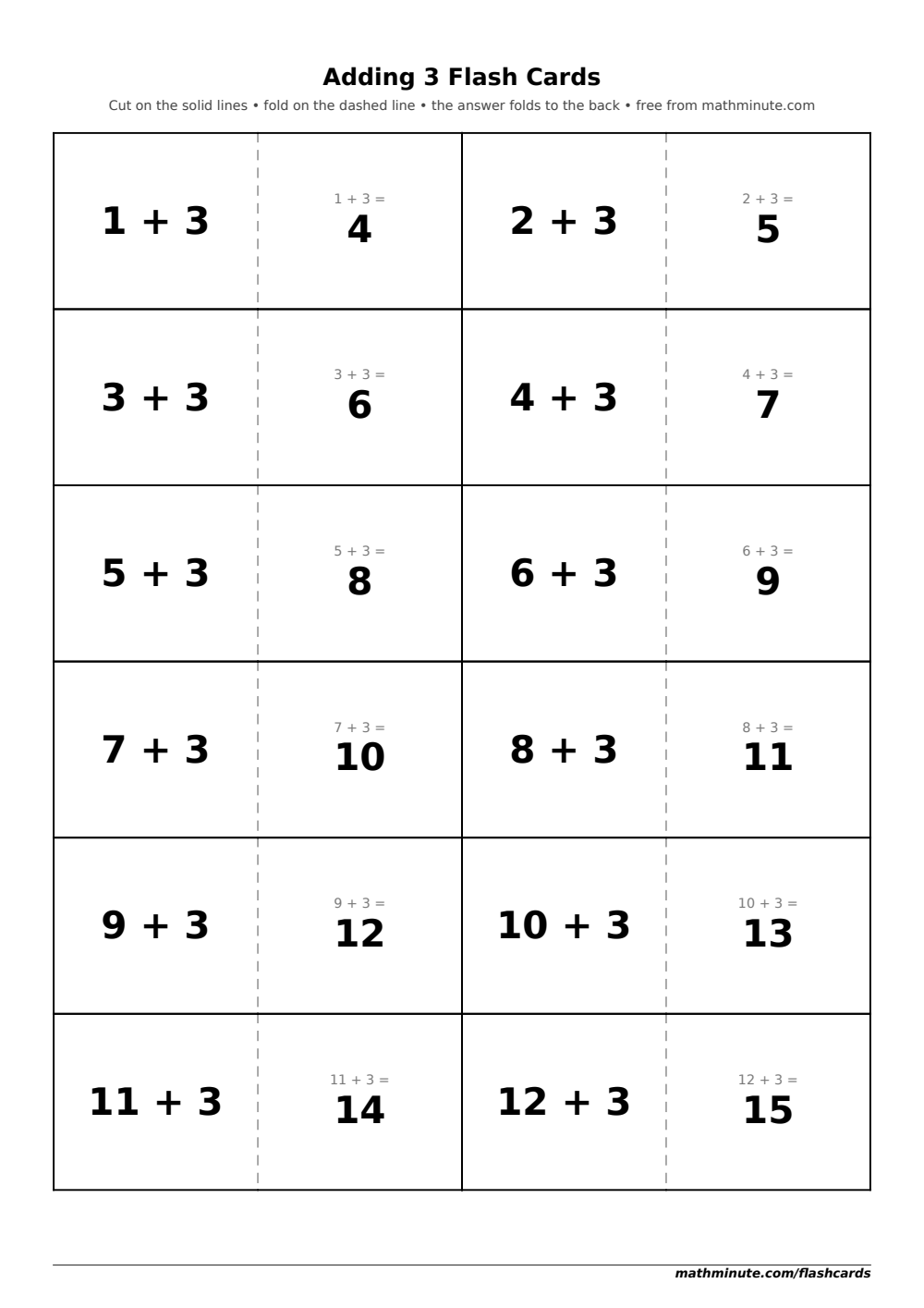
Adding 3 is the last family where counting on still works well — three hops from the bigger number. Past this point, good strategies replace counting. These fold-over flashcards cover 1 + 3 through 12 + 3.
How to Use These Flash Cards
Count on from the larger number: for 8 + 3, start at 8 and hop three — 3 more than 8 beats 8 more than 3. Watch for the ten-crossers (7 + 3, 8 + 3, 9 + 3) — they are the cards doing the most work, because crossing ten smoothly is exactly the skill the make-ten families will need.
How to Cut and Fold
- Print the PDF single-sided on plain paper or light cardstock.
- Cut along the solid lines to separate the cards.
- Fold each card along the dashed center line so the answer sits behind the question, and turn the card over like a page to check.
- Optional: a dab of glue inside the fold makes a sturdy double-thick card.
Frequently Asked Questions
Why is +3 called the last counting-on family?
Three hops is about the limit a child can count accurately and quickly in their head. From +4 upward, strategies like doubles and make-ten are faster and less error-prone than counting.
What is special about 7 + 3?
It makes exactly ten — one of the "make ten" partner pairs (7 and 3, 6 and 4, 8 and 2) worth knowing cold, because the make-ten strategy for bigger facts is built from them.
Should a child use fingers for +3 facts?
Early on, yes — fingers make counting on visible. The flashcards then wean it: when a card comes back often enough, recall overtakes the fingers naturally.