Printable Perfect Squares Flash Cards
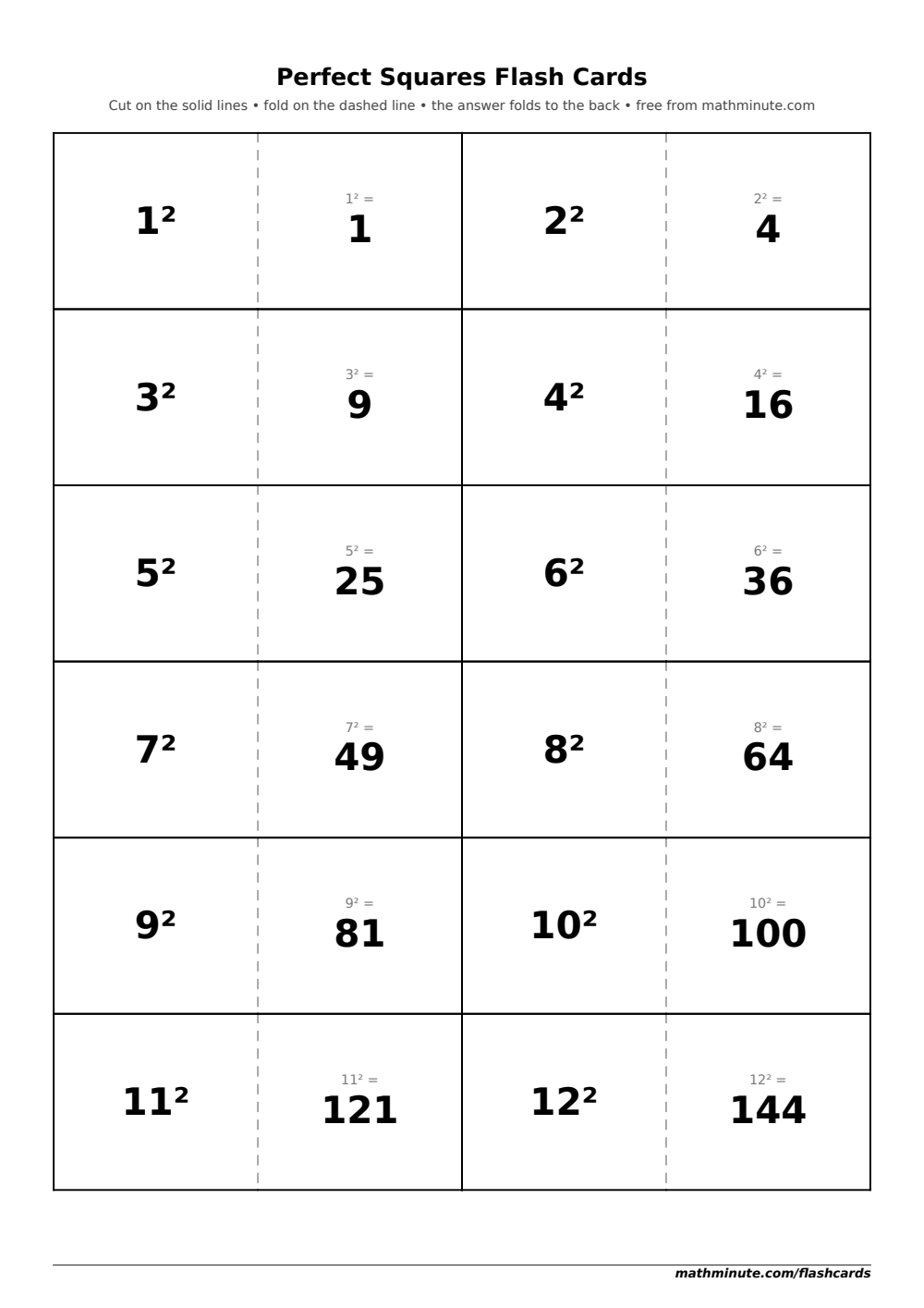
The perfect squares run down the shaded diagonal of the multiplication chart — 1, 4, 9, 16, up to 144 — and they are the facts pre-algebra leans on for square roots, area, and quadratics later. A square is literally a square: 5² is 25 dots arranged 5 by 5. These fold-over flashcards cover 1² through 12².
How to Use These Flash Cards
Most of the deck is already known from the times tables — 6² is just 6 × 6 — so drill the notation as much as the numbers: read 7² aloud as "seven squared". Show the growth pattern as a hook: the squares climb by the odd numbers (1, 4, 9, 16 — gaps of 3, 5, 7), so each square is the last one plus the next odd number.
How to Cut and Fold
- Print the PDF single-sided on plain paper or light cardstock.
- Cut along the solid lines to separate the cards.
- Fold each card along the dashed center line so the answer sits behind the question, and turn the card over like a page to check.
- Optional: a dab of glue inside the fold makes a sturdy double-thick card.
Frequently Asked Questions
Why are they called perfect squares?
Because that many dots arrange into an exact square: 16 dots make a 4-by-4 grid. The exponent notation 4² just abbreviates 4 × 4 — the geometry came first.
What is the odd-number pattern in the squares?
Consecutive squares differ by consecutive odd numbers: 1, 4, 9, 16, 25 climb by 3, 5, 7, 9. So the next square is always the current one plus the next odd number — a quick way to rebuild a forgotten fact.
Why memorize squares through 12²?
They anchor square roots (√81 is instant if 9² is), estimation (√90 sits between 9 and 10), and later factoring in algebra. The squares are the multiplication facts that keep paying off longest.