Printable Adding 6 Flash Cards
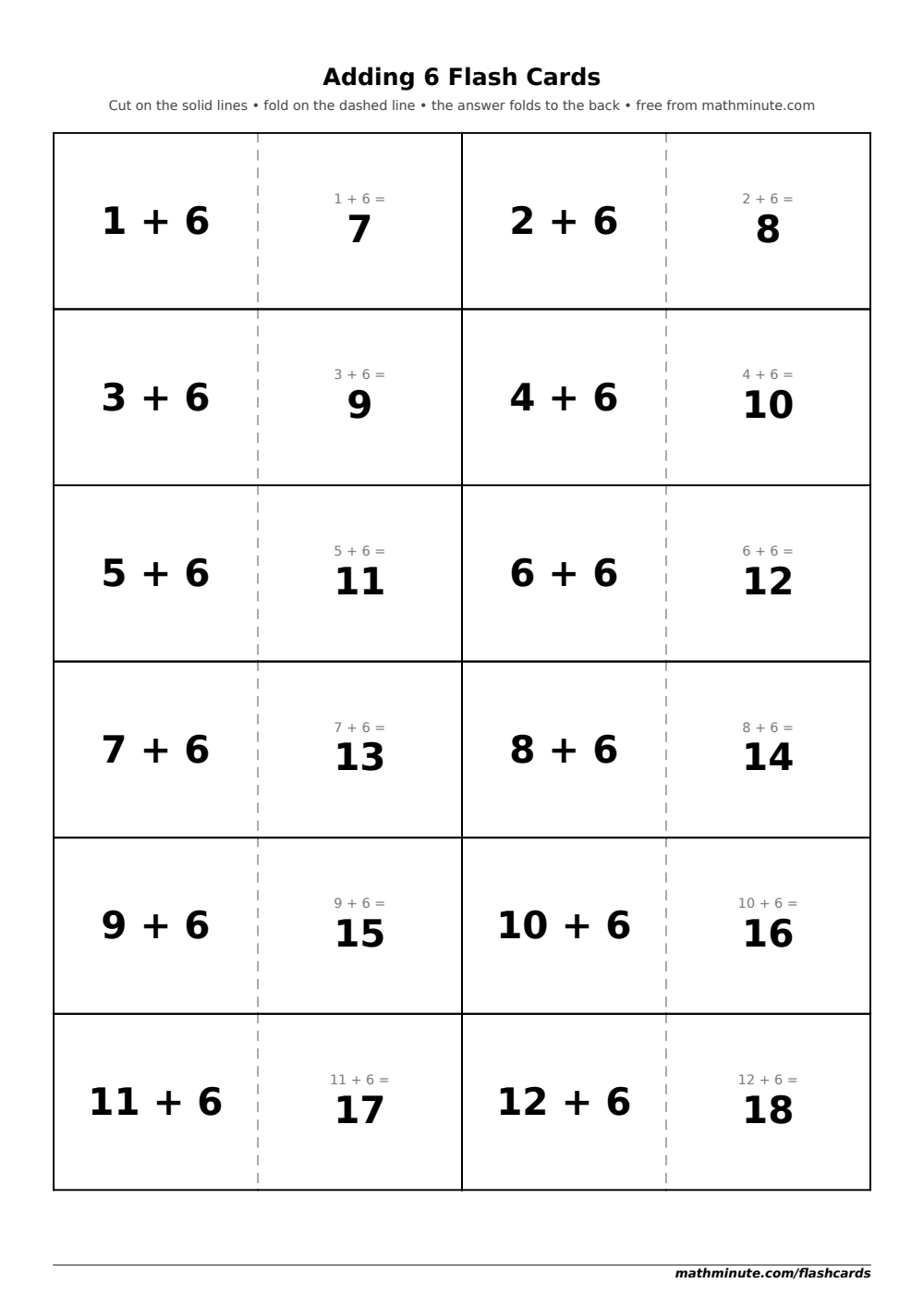
Adding 6 lives in make-ten territory: for the big cards, feed the ten first — 8 + 6 gives 2 to the 8, leaving 4, so 14. The double 6 + 6 = 12 anchors the middle of the deck. These fold-over flashcards cover 1 + 6 through 12 + 6.
How to Use These Flash Cards
Drill the tools before the deck: 6 + 4 = 10 (the partner fact) and 6 + 6 = 12 (the double). Then every hard card has a route — 7 + 6 is the double 6 + 6 and one more, 9 + 6 fills the 9 and leaves 5. Say the strategy aloud on flips until it goes silent on its own.
How to Cut and Fold
- Print the PDF single-sided on plain paper or light cardstock.
- Cut along the solid lines to separate the cards.
- Fold each card along the dashed center line so the answer sits behind the question, and turn the card over like a page to check.
- Optional: a dab of glue inside the fold makes a sturdy double-thick card.
Frequently Asked Questions
What is the make-ten strategy for +6 facts?
Split the 6 to fill the other number up to ten: for 8 + 6, the 8 needs 2, so 6 becomes 2 + 4 and the answer is 10 + 4 = 14. It turns every ten-crossing card into a ten-plus fact.
How does the double 6 + 6 help its neighbors?
Near-doubles borrow it: 7 + 6 is one more than 6 + 6, so 13; 6 + 5 is one less, so 11. One memorized double covers three facts.
Which +6 facts belong in the repeat pile?
7 + 6 = 13, 8 + 6 = 14, and 9 + 6 = 15 — the ten-crossers. They are also exactly the facts the make-ten strategy is built for, so stalling there just means more strategy practice.