Printable Adding 10 Flash Cards
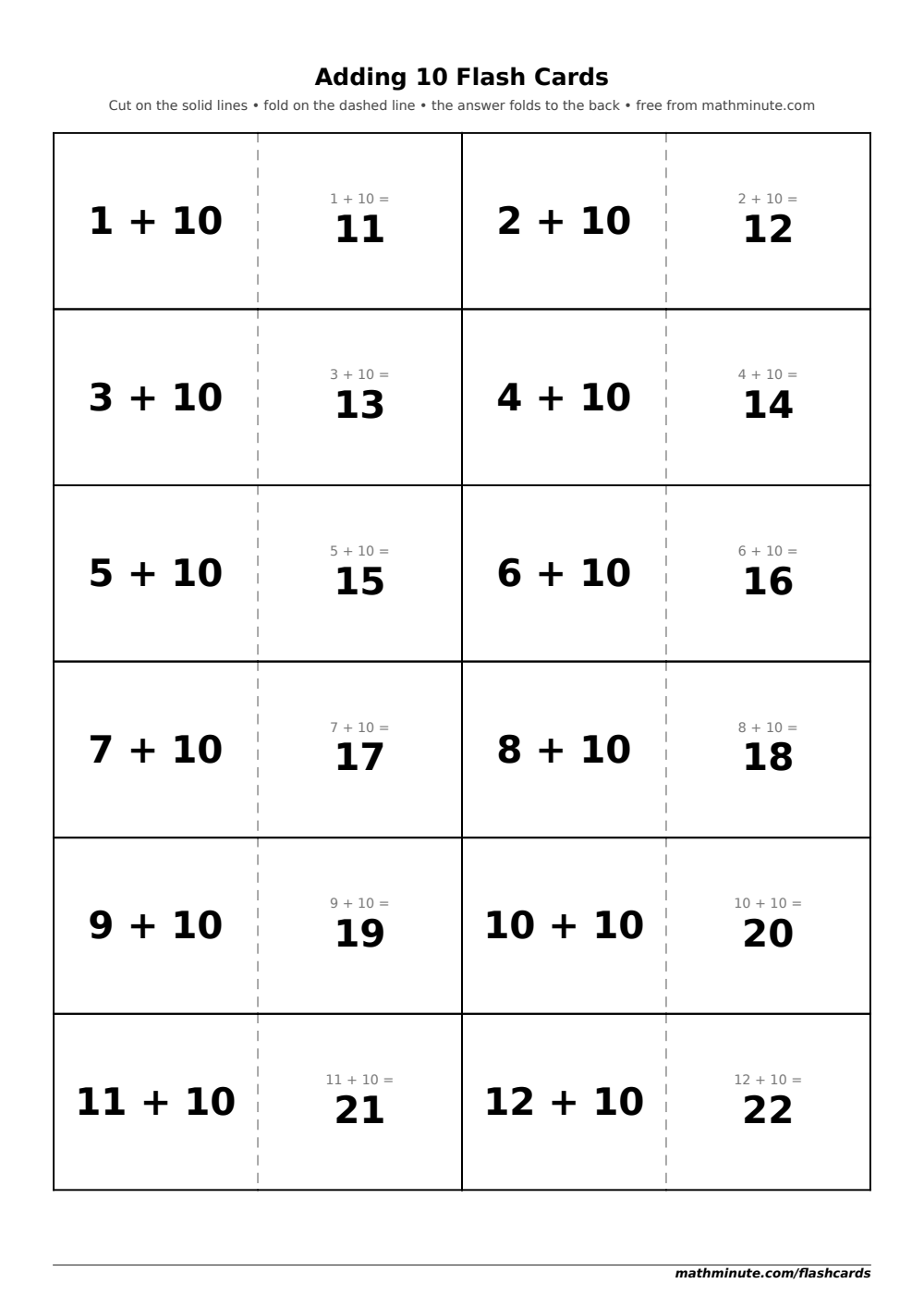
Adding 10 is place value in practice: 7 + 10 = 17 because the ten goes in the tens column and the 7 stays put. These fold-over flashcards cover 1 + 10 through 12 + 10 — the deck that turns "teen" numbers into ten-and-some.
How to Use These Flash Cards
Say the answers with their structure: 17 is "ten and seven". This deck should run nearly instantly — its job is cementing the ten-plus form that +8 and +9 borrow. If 4 + 10 stalls, build it with objects once: a ten-stack and four loose, then read the number off.
How to Cut and Fold
- Print the PDF single-sided on plain paper or light cardstock.
- Cut along the solid lines to separate the cards.
- Fold each card along the dashed center line so the answer sits behind the question, and turn the card over like a page to check.
- Optional: a dab of glue inside the fold makes a sturdy double-thick card.
Frequently Asked Questions
Why does adding 10 not change the ones digit?
The ten goes into the tens place and the ones place is untouched: 6 + 10 = 16. That is place value in its simplest visible form, and it is why teen numbers are "ten and some more".
If +10 is so easy, why have a deck for it?
Because the harder strategies stand on it: make-ten turns 8 + 6 into 10 + 4, and the +9 trick is add-ten-take-one. A child who owns the ten-plus facts gets those strategies almost free.
What comes after the +10 facts?
Using them: the make-ten families (+6, +7, +8) and the +9 trick, then two-digit addition where "add the tens, add the ones" is the same idea at full size.