Printable Measurement Conversion Chart
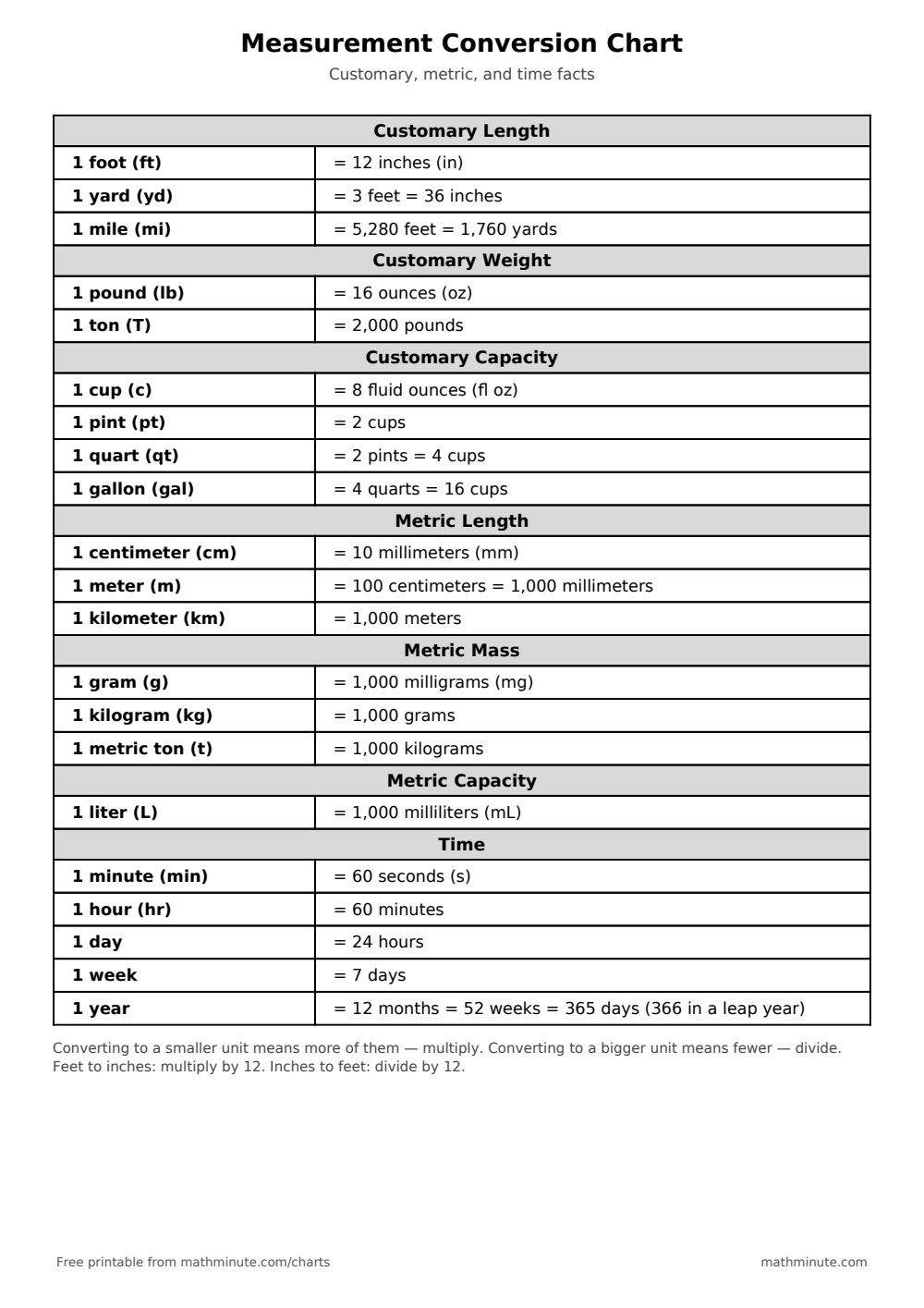
Every measurement conversion fact elementary students are expected to know, on one reference page: customary length, weight, and capacity; metric length, mass, and capacity; and the time facts from seconds to years. These are exactly the conversions the measurement worksheets and the timed game drill — 12 inches to the foot, 16 ounces to the pound, 1,000 meters to the kilometer.
How to Use a Conversion Chart
Teach the one rule that governs every row: converting to a smaller unit means you need more of them, so multiply; converting to a bigger unit means fewer, so divide. Feet to inches is × 12, inches to feet is ÷ 12. Students who reason "smaller unit, bigger number" stop guessing which operation to use — the single most common conversion error.
Keep the two systems separate in practice: metric conversions are all powers of ten (a place-value shift), while customary facts simply have to be known. Anchor them to real objects — a ruler is a foot, a milk jug is a gallon, a paperclip weighs about a gram. Then drill with the timed measurement game, with the measurement conversions guide for the full method.
Frequently Asked Questions
How do you know whether to multiply or divide when converting?
Think about the size of the unit: smaller units mean more of them, bigger units mean fewer. Converting 3 feet to inches goes to a smaller unit, so multiply by 12 to get 36. Converting 36 inches to feet goes bigger, so divide by 12.
Why are metric conversions easier than customary ones?
Metric units are built on powers of ten — 10 mm in a cm, 100 cm in a m, 1,000 m in a km — so converting is just shifting place value. Customary factors (12, 3, 5,280, 16) follow no pattern and have to be memorized, which is what a reference chart is for.
Which conversion facts do students need by grade?
Roughly: time facts and inches-feet-yards in 2nd and 3rd grade; pounds-ounces, cups-pints-quarts-gallons, and basic metric length in 3rd and 4th; the full metric system and multi-step conversions like miles to feet in 4th and 5th.