Printable Clock Face Chart
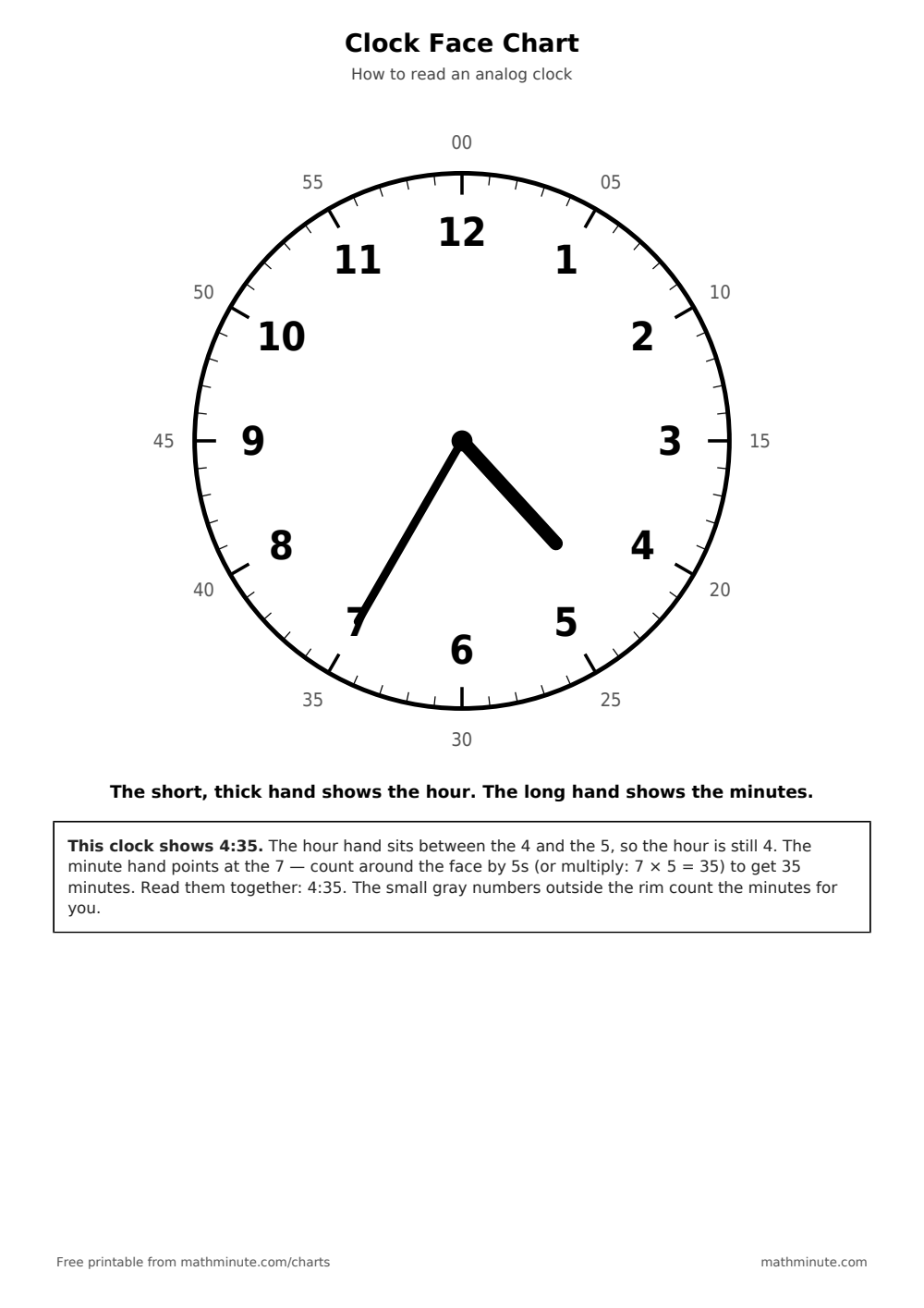
A large, clearly labeled analog clock face built for teaching: hour numbers inside the rim, minute numbers counted by 5s outside it, all sixty minute ticks, and the hands set to a worked example (4:35) with the reading explained underneath. The second download is a page of six blank clock faces for practice — draw the hands, or read a partner's and write the time.
How to Teach Clock Reading with This Chart
Always read the hour hand first: it is the short, thick one, and whatever number it last passed is the hour — even when it sits closer to the next number. That is the classic stumble: at 4:55 the hour hand nearly touches the 5, and most beginners say "5 o'clock." The worked example on the chart (4:35) makes the rule concrete: between 4 and 5 still means 4.
Then the minute hand, which is really a 5 times table in disguise: pointing at the 7 means 7 × 5 = 35 minutes — the outer gray numbers do the multiplication for you until it is automatic. Print the blank faces and run it both directions: you say a time and they draw it, they draw a time and you read it. The telling time guide covers the full progression, and the timed time game keeps it sharp.
Frequently Asked Questions
How do you read an analog clock?
Hour hand first: the short, thick hand shows the hour, and the hour is the number it most recently passed. Then the minute hand: the long hand counts minutes by 5s — pointing at the 7 means 35 minutes. Read them together: hour, then minutes.
Why does the minute hand count by 5s?
The face has 12 numbers but an hour has 60 minutes, so each number is worth 60 ÷ 12 = 5 minutes. That is why telling time and the 5 times table are taught together — reading the minute hand at the 7 is literally computing 7 × 5.
Why do kids misread the hour hand?
Because it moves continuously: at 4:35 it sits more than halfway from 4 to 5, and at 4:55 it almost touches the 5. Beginners read the nearest number instead of the last number passed. Practicing times late in the hour on the blank faces is the fastest way to fix it.