Printable Hundreds Chart (1–100)
The hundreds chart is one of the hardest-working tools in early math: the numbers 1 to 100 in a ten-by-ten grid, where every step down adds ten and every step right adds one. That structure makes patterns visible — skip counting, evens and odds, and the place-value logic behind two-digit arithmetic.
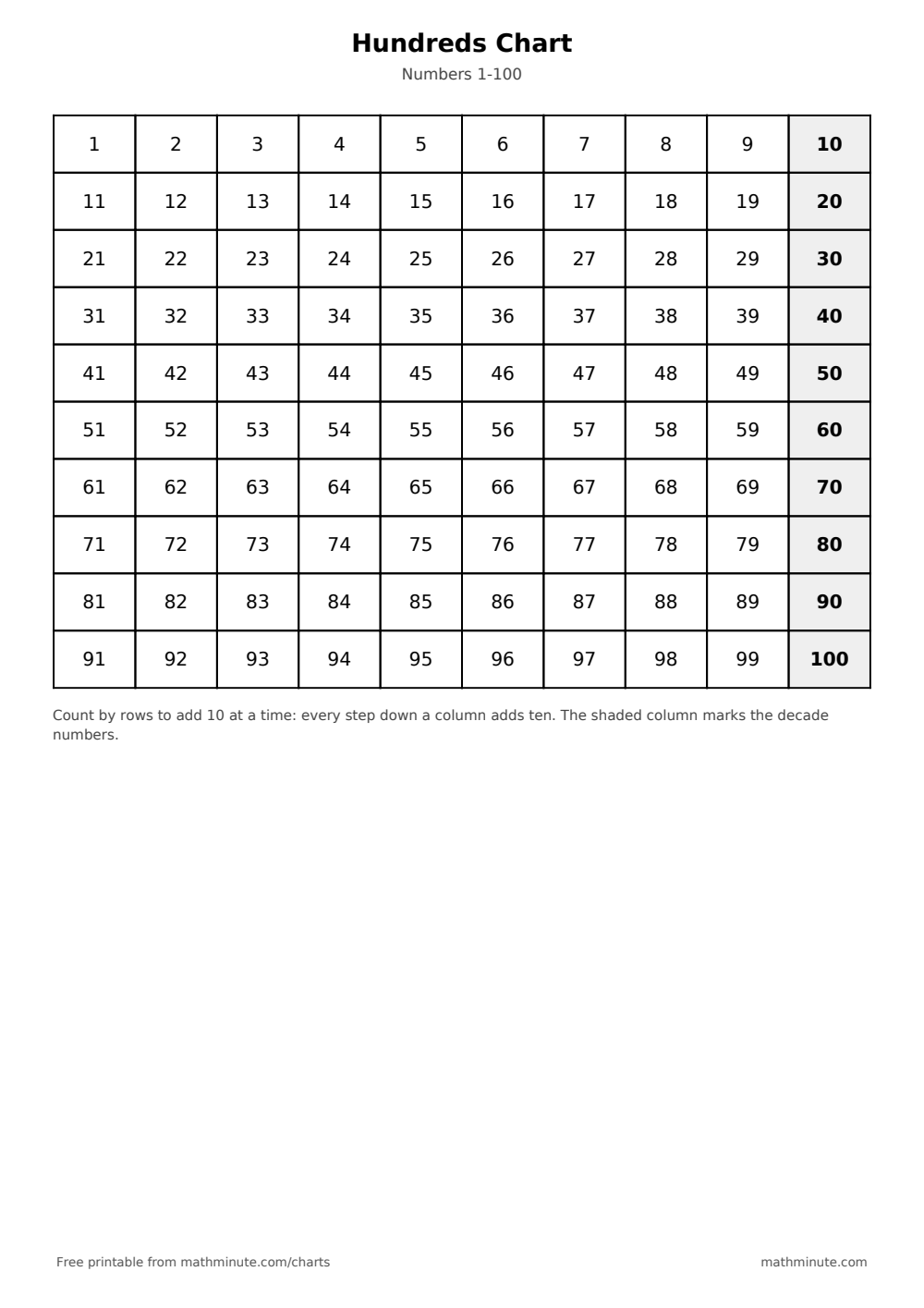
The Hundreds Chart at a Glance
| 1 | 2 | 3 | 4 | 5 | 6 | 7 | 8 | 9 | 10 |
| 11 | 12 | 13 | 14 | 15 | 16 | 17 | 18 | 19 | 20 |
| 21 | 22 | 23 | 24 | 25 | 26 | 27 | 28 | 29 | 30 |
| 31 | 32 | 33 | 34 | 35 | 36 | 37 | 38 | 39 | 40 |
| 41 | 42 | 43 | 44 | 45 | 46 | 47 | 48 | 49 | 50 |
| 51 | 52 | 53 | 54 | 55 | 56 | 57 | 58 | 59 | 60 |
| 61 | 62 | 63 | 64 | 65 | 66 | 67 | 68 | 69 | 70 |
| 71 | 72 | 73 | 74 | 75 | 76 | 77 | 78 | 79 | 80 |
| 81 | 82 | 83 | 84 | 85 | 86 | 87 | 88 | 89 | 90 |
| 91 | 92 | 93 | 94 | 95 | 96 | 97 | 98 | 99 | 100 |
How to Use a Hundreds Chart
Young learners start by counting and coloring: shade every second square to see the even numbers, every fifth to see the 5s pattern, every tenth to watch the decade column light up. Older students use it for mental math — adding 10 is one hop down, adding 9 is a hop down and a step left, which is exactly the regrouping insight two-digit arithmetic depends on.
The blank grid turns all of that into practice: fill in rows from memory, fill only the shaded decade column, or play "missing neighbors" by writing a number and asking which numbers live above, below, and beside it. When counting feels solid, the addition facts game is the natural next step.
Frequently Asked Questions
What is a hundreds chart used for?
Counting, skip counting, seeing even/odd and multiples patterns, and building place-value intuition — on the chart, adding 10 is exactly one row down, which prepares students for two-digit addition and subtraction.
What age is a hundreds chart for?
Mostly kindergarten through 2nd grade — from learning to count past 20, through skip counting, to adding and subtracting with tens and ones. It also helps older students who need place-value reinforcement.
What can I do with a blank hundreds chart?
Filling it in from memory is the classic exercise. Variations: fill only one row or column, fill every fifth number, or write a few scattered numbers and have the student fill the neighbors around them.